 |
| A street in the Old City of Plovdiv |
If you were to visit Bulgaria, one of the first things that
you would probably notice is that it invites a sense of the poetic. Vitosha,
the great mountain that towers above Sofia to the south, is one of those
places. Climb high enough and you will see the golden dome of St. Alexander
Nevsky Cathedral as well as the other monuments for which downtown Sofia is so
well known. Standing on top of that mountain, a man is forced to think in
poetic terms about the shortness of life, the beauty of the world, and our
communion with nature and each other.
Walking through the old streets of Plovdiv, I had that same
poetic feeling steeling over me as I stared down at my feet and tried to not
trip over the cobblestones in the Old Town. I thought about history and how
this city had been continuously inhabited for thousands of years. I was the
descendant of those generations and so were my colleagues and students. In this
city, I felt tied to my roots in a way that is difficult to describe with
words. I never felt more alive than on a March afternoon as I wandered taking
picture after picture of places I loved. It was one of the few times in my life
when, in the words of the great Russian composer Alexander Scriabin, “the whole
word resounded with one ecstatic cry, ‘I am!’”
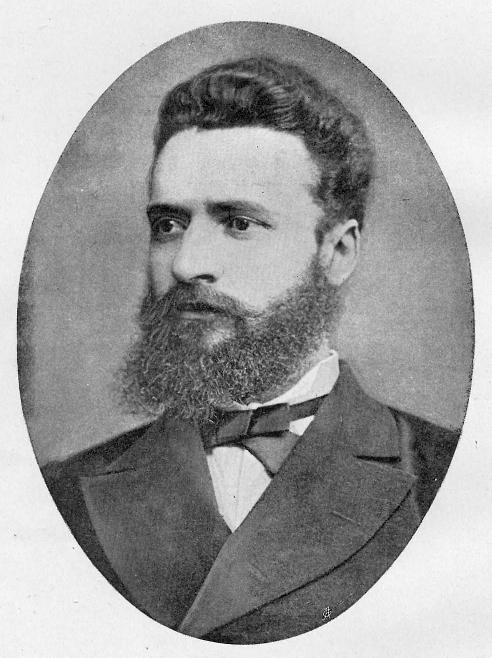 |
| Hristo Botev - Bulgaria's most famous poet |
I grew up with the Bulgarian culture and poetry of my
ancestors in far off America. I learned the poetry of Hristo Botev and Ivan
Vazov as a boy. I memorized “The Hanging of Vasil Levski” and “Hadji Dimitar”
around the same time I was reading Whitman in English for the first time. Every
time I read or recite those poems, I can heart my step-grandfather’s voice
echoing in my ears. The man was not a poet. He was a banker, but he recited
those poems like nobody else I knew with feeling, patriotism, and love.
I started writing poetry as a teenager. It was the kind of
rhyming stuff that most people come up with at that age. It’s imitation
Browning and Tennyson without the former’s sense of history and latter’s
prosody. It could pass for Robert Frost on one of his worst days or even very
young Hemingway. I remember giving it to a professor of mine in college. A
wizened German woman named Ms. McAuley who gave me Ginsberg to read.
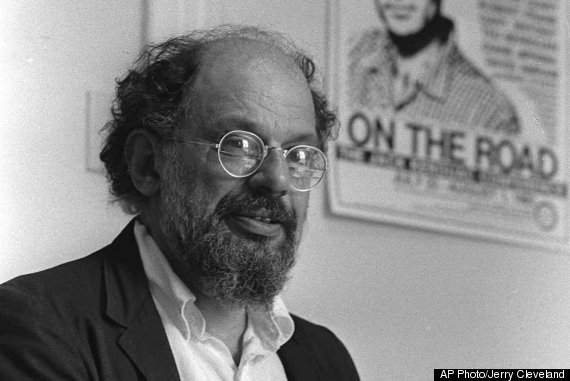 |
| Allen Ginsberg |
I wrote poetry for years after that. I filled notebook after
notebook and binder after binder with my chicken scratch. I consumed Komunyakaa
and Adrienne Rich collections as if it were my birthright. I went to writing
workshops, criticized the hell out of my classmates, and won the professor’s
approval. I wrote about death, life, and everything in between. I was
infatuated with poetry. I was madly in love with the possibility of sound.
I stopped writing poetry ten years ago. I’m not sure how it
happened that the bottom dropped out. One moment, I was madly scribbling away.
The next, my notebooks were gathering dust in the back of a closet together
with old forms and letters and piano exam evaluations. I tried to write. I
truly sat there for hours on end trying to find that single silver thread, but
it never came.
 |
| One of the many books I read in Bulgaria. |
Going on my Fulbright, I found poetry again. Not only in the
landscape of the country I was born in, but in the books I was reading. I
ploughed through Lope de Vega, Dimcho Debelyanov, and a hundred other thin
books of poetry as well as anthologies of well known authors. I taught the
Shakespeare sonnets. I once managed to somehow declaim “The Raven.” I fell in
love again.
Poetry is that one art that works when nothing else does.
When we want to capture the mood of a moment, we can take a picture. It lasts
for years, but we can also write poetry. The lyric poem is founded on that
idea. It was something the ancient Greeks discovered a long time ago. The idea
that we could compress a moment of time through words and preserve that image
we saw before us.
Poetry preserves our memory, but it also moves. We write it
because we need to express ourselves in a way that is not easily understood by
those around us. We bare our souls in poetry and we allow others to empathize.
You cannot read “The Raven” without pinpricks on your neck or “Song of Myself”
without a feeling of inward exultation. For a few moments, we live in the poet’s
world and it becomes our world. We see what he sees, we understand what he
understands.
I am still a poet for I was born in a country that has given
birth to them since Orpheus. While I may not write in iambic pentameter, rhyme,
or use any other device, I am a poetry because I see the world as the poet
does. It is a world of tremendous beauty as fragile as the leaf fall off a tree
and twisting in the wind full of tragedy and joy.

