Monday, June 8, 2015

Schism begets Schism

"I am the Vine and you are the branches." 


If you follow news about religion long enough or read enough church history, one of the patterns you will recognize is that schisms beget schisms. When Martin Luther protested against the excesses of the Catholic Church, he ended up in schism. When groups of Luther's followers refused to go along with his teaching, another split occurred and so on and so forth.

You don’t have to look far into the dark mists of history to find this pattern. As a matter of fact, it exists in the United States in the world of traditionalist Catholicism. Traditional Catholicism is renowned for its devotion to the Latin Mass and the Roman Catholic Church as it was before Vatican II. There are various stripes of traditional Catholics from those who work within the Church and accept the Pope to those who do not wish to have anything with it and believe the current occupant of the Chair of St. Peter to be a heretic.

In the 1980s, a schism occurred between a group of nine priests and the Society of St. Pius X (SSPX). The Nine went against Archbishop Lefevbre, the founder of the largest traditional group in the world, because of various issues that they could not reconcile with their own beliefs. For example, they thought that the Roman Missal that should be used at Mass was the one printed immediately before 1955 and the restoration of Holy Week. Another issues was the acceptance by the SSPX of priests ordained in the institutional Roman Catholic Church. Since these clerics were ordained by bishops who had been consecrated after 1968 when a new form of episcopal consecration was introduced, the hard liners believed that they should have been re-ordained rather than just accepted and sent off to work in the mission fields. Finally, there was the issue of the Papacy. The hard liners believed that the Chair of St. Peter was empty, while the SSPX is loyal to the Pope despite giving itself the right to sift through his teaching and use only those that they find relevant.

The hard liners, after a series of law suits, managed to form their group and called it the Society of St. Pius V (SSPV). The group was very much centralized by Bishop Clarence Kelly and headquartered in Oyster Bay Cove, New York. Within a few years, half of the original nine priests were to leave the SSPV. Some of them went onto independent work in various chapels and missions, while a few formed their own organization called “Catholic Restoration” and were by Fathers (later Bishops) Donald Sanborn and Daniel Dolan.

The main point of chronicling these splits is to show that schism is a fact of life in the world of traditional Catholicism. The SSPX had issues with the Vatican, the Nine had problems with the SSPX, Dolan and Sanborn left the SSPV and did their own thing. Split after split after split. These seem to indicate that there is something wrong with these groups that claim to be Roman Catholic and yet do not recognize the Pope as Christ’s Vicar on earth.

You see, the problem with schism is that the schismatic group is essentially on its own. There are some people out there who will argue that the fruits of the sedevacantists and the SSPX are better than those of the Church herself. While there is some truth to this, one should also examine the fruits of these groups as well. Schism after schism and scandal after scandal have been a part of the life of the sedevacanist movement since it was first founded. While some sedevacantist groups are better than others, sooner or later one hears of yet another split. Father So and So was kicked out by Bishop So and So because he refused to toe the party line or decided to defend defenseless children against an abusive school principal.

These things are not accidental. As the saying goes, there is no salvation of outside of the Church. The Holy Spirit does not reside among schismatics and others who believe that they are better than the Church they left behind. Charity does not live here nor will it. Look around at the fruits of the sedevacantists and tell me if there is any good coming out of their groups that is not scandal or schism or a priest who guilt trips his congregation on a routine basis for money so that he can go on expensive junkets to Mexico and Australia.

Friday, June 5, 2015

Rendering to God

 
John Singleton Copley - The Tribute Money (1782) 

A few days ago, I wrote an article about Patriarch Kirill and the Russian Orthodox Church. In that article, I mentioned that the Russian government and the Church were collaborating together to establish a new order in Russia. Without resurrecting that horse, I feel that it is necessary for me to talk about the Church’s involvement in political affairs.

Metropolitan Jonah, retired Primate of the Orthodox Church in America, has been giving a series of lectures at St. John the Baptist Cathedral in Washington, DC. The lectures themselves focus on various aspects of the Orthodox faith and are very interesting. His Beatitude, however, recently talked about politics. In a discussion he delivered about Orthopraxy, he talked about the destruction of the inner city, libertarianism, and other aspects of current affairs that have no place in a discussion of Orthopraxy (practice of the Church).

Personally, I don’t mind it if bishops and priests have their own political ideas. I don’t mind if they discuss said ideas on the internet. What I mind is when politics is discussed from the pulpit and when the Church gets involved in issues that do not directly have anything to do with her.

Not so long ago, I was watching an interview with a traditionalist Roman Catholic priest out in California. His interviewer asked him if it was okay to preach about politics from the pulpit during an election season. Father X. pointed out that it was not his business to tell people who to vote for and what issues to vote on. From the pulpit, he was allowed to talk about the moral implications of said issues, but not to state outright how people should vote and what they should think.

You see, there is a massive difference between preaching about morality from the pulpit and gathering votes for your favorite candidate. A priest can talk about how immoral abortion is and what a problem it creates in terms of demography. However, he should not talk about which candidate he personally endorses for the Senate. A hieromonk can preach against homosexuality, but he has no right to tell people how to vote.

The problem I had when listening to Metropolitan Jonah’s lecture (since deleted from YouTube) was that he was telling his listeners and, by extension, the viewers what to think and how to feel. I told a friend of mine that if he endorsed monarchism as the Orthodox way of ruling, then I would shut down the thing. Mercifully, there was nothing like that.

The Church has never stated what the appropriate form of government should or should not be. Russian monarchists will tell you that monarchy works best. However, Russian history indicates that monarchy only works well when you have somebody ruling with a strong fist like Ivan the Terrible or Peter the Great. While those men were anointed by bishops to serve Russia as monarchs, the Church in no way has endorsed monarchy as being the right form of government.

You see, the Church is beyond politics. In the early centuries and for most of Church history, believers have tried not to stand out. If they held public office, they kept their faith personal. Only when they themselves were affected would they speak truth to power. For example, St. Demetrius was ordered by the governor of Thessalonica to persecute the Christians in the city. When he told the governor that he wouldn’t do it because it was against his religion, only then did he confess to being a Christian. Not before.


In the Gospels, Christ stated outright that we should “render to Caesar the things that are Caesar’s and to God the things that are God’s.” Caesar represents the government and the political life of the world in which we live. We are to fill out our taxes, vote, and do what is appropriate for us as citizens. However, we should not mix our spiritual life up with the political world in which we live. 

Tuesday, June 2, 2015

Poetry Will Serve


A street in the Old City of Plovdiv 

If you were to visit Bulgaria, one of the first things that you would probably notice is that it invites a sense of the poetic. Vitosha, the great mountain that towers above Sofia to the south, is one of those places. Climb high enough and you will see the golden dome of St. Alexander Nevsky Cathedral as well as the other monuments for which downtown Sofia is so well known. Standing on top of that mountain, a man is forced to think in poetic terms about the shortness of life, the beauty of the world, and our communion with nature and each other.

Walking through the old streets of Plovdiv, I had that same poetic feeling steeling over me as I stared down at my feet and tried to not trip over the cobblestones in the Old Town. I thought about history and how this city had been continuously inhabited for thousands of years. I was the descendant of those generations and so were my colleagues and students. In this city, I felt tied to my roots in a way that is difficult to describe with words. I never felt more alive than on a March afternoon as I wandered taking picture after picture of places I loved. It was one of the few times in my life when, in the words of the great Russian composer Alexander Scriabin, “the whole word resounded with one ecstatic cry, ‘I am!’”

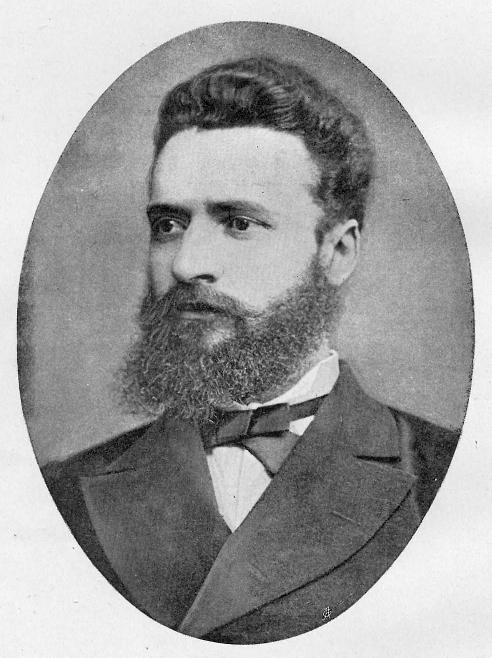
Hristo Botev - Bulgaria's most famous poet


I grew up with the Bulgarian culture and poetry of my ancestors in far off America. I learned the poetry of Hristo Botev and Ivan Vazov as a boy. I memorized “The Hanging of Vasil Levski” and “Hadji Dimitar” around the same time I was reading Whitman in English for the first time. Every time I read or recite those poems, I can heart my step-grandfather’s voice echoing in my ears. The man was not a poet. He was a banker, but he recited those poems like nobody else I knew with feeling, patriotism, and love.

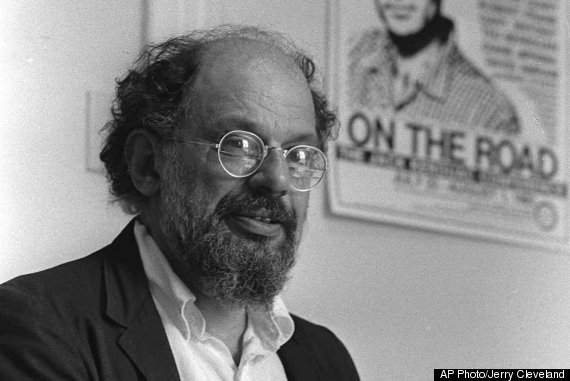
I started writing poetry as a teenager. It was the kind of rhyming stuff that most people come up with at that age. It’s imitation Browning and Tennyson without the former’s sense of history and latter’s prosody. It could pass for Robert Frost on one of his worst days or even very young Hemingway. I remember giving it to a professor of mine in college. A wizened German woman named Ms. McAuley who gave me Ginsberg to read.

Allen Ginsberg 

I wrote poetry for years after that. I filled notebook after notebook and binder after binder with my chicken scratch. I consumed Komunyakaa and Adrienne Rich collections as if it were my birthright. I went to writing workshops, criticized the hell out of my classmates, and won the professor’s approval. I wrote about death, life, and everything in between. I was infatuated with poetry. I was madly in love with the possibility of sound.

I stopped writing poetry ten years ago. I’m not sure how it happened that the bottom dropped out. One moment, I was madly scribbling away. The next, my notebooks were gathering dust in the back of a closet together with old forms and letters and piano exam evaluations. I tried to write. I truly sat there for hours on end trying to find that single silver thread, but it never came.

One of the many books I read in Bulgaria. 

Going on my Fulbright, I found poetry again. Not only in the landscape of the country I was born in, but in the books I was reading. I ploughed through Lope de Vega, Dimcho Debelyanov, and a hundred other thin books of poetry as well as anthologies of well known authors. I taught the Shakespeare sonnets. I once managed to somehow declaim “The Raven.” I fell in love again.

Poetry is that one art that works when nothing else does. When we want to capture the mood of a moment, we can take a picture. It lasts for years, but we can also write poetry. The lyric poem is founded on that idea. It was something the ancient Greeks discovered a long time ago. The idea that we could compress a moment of time through words and preserve that image we saw before us.

Poetry preserves our memory, but it also moves. We write it because we need to express ourselves in a way that is not easily understood by those around us. We bare our souls in poetry and we allow others to empathize. You cannot read “The Raven” without pinpricks on your neck or “Song of Myself” without a feeling of inward exultation. For a few moments, we live in the poet’s world and it becomes our world. We see what he sees, we understand what he understands.


I am still a poet for I was born in a country that has given birth to them since Orpheus. While I may not write in iambic pentameter, rhyme, or use any other device, I am a poetry because I see the world as the poet does. It is a world of tremendous beauty as fragile as the leaf fall off a tree and twisting in the wind full of tragedy and joy. 

Monday, June 1, 2015

All's Not Quiet on Eastern Front


In 2009, Patriarch Kirill was elected to be the head of the Russian Orthodox Church. In the six years since his installation, there has been a great deal of debate about the inner corruption of the church and its work with the government. For the most part, the voices of the grassroots activists have not been heard outside of Russia or they have been completely ignored because of their unpopular opinions. The following is a list of grievances that I have gleaned from watching various videos on YouTube in Russian.

1. Fascist treatment of non-mainstream Orthodox groups. In an address given several years ago, Patriarch Kirill referred to the members of the Russian Orthodox Autonomous Church (ROAC) and other catacomb groups which do not recognize him as “subhuman sectants.” There have been numerous attempts by the Moscow Patriarchate and the Russian government to shut down these groups. In Udmurtia, the parish church of Tsar-Martyr Nicholas was evicted from its property several times by the local diocese and patriarchate. In Suzdal, the ROAC and the government as well as the Moscow Patriarchate have been engaged in a long standing legal dispute over an ancient church in the historic city as well as the relics of a local saint.

The Moscow Patriarchate wants to stamp out all opposition in Russia that comes from non-MP groups. It views all of these groups as schismatic and, therefore, not worthy of being treated with any respect. In a Moscow suburb, there has been a case where a local catacomb family was forcibly evicted from its property by a parish priest who wanted to expand his church building. It is simply inconceivable why Father X. couldn’t build his church in the opposite direction or build on the land he was already given. 


2. The Collaboration between the Church and the Government. This item is not new. The symbol of the Russian tsars and the Byzantine emperors was the double-headed eagle, which symbolized the emperor and the patriarch working together. During the latter years of tsarist rule in Russia, the Holy Synod of the Russian Orthodox Church worked in close collaboration with the regime because it was a government department under the personal rule of an ober-procurator who was responsible to the tsar. (This was one of Peter the Great’s many church reforms, but that’s a discussion for another day.)

In today’s Russia, most politicians and oligarchs portray themselves as being Orthodox. There are many photographs of Vladimir Putin and Patriarch Kirill that make their way into newspapers. The Church has a strong lobby in the parliament and is able to lobby for educational and other reforms that are basically rubber stamped by the Kremlin since they go along with its party line.

One of the most recent reforms under discussion in Russia is the teaching of catechism classes beginning in the second grade.  This initiative was put forward by Patriarch Kirill himself. However, it flies in the face of the Russian constitution where it states, in language similar to our own Bill of Rights, that government shall create a state religion or impose one. Unfortunately, mandatory catechism classes in public schools violates freedom of religion in Russia and creates problems for educators since Russian public schools have been secular since 1917.


3. Corruption of the Clergy. This is not a new issue either. In tsarist Russia, there were numerous members of the clergy who were skin flints, drunkards, or worse. However, tsarist Russia did not have YouTube, iPhones, or any other methods for recording and reporting the corruption of the clergy and making it public. Due to the internet, a great of clergy corruption has been exposed for the whole world to see.

Patriarch Kirill’s lavish lifestyle including a palatial residence outside of Moscow that is currently being built for him as well as expensive watch (Photoshopped out of photographs) have come under criticism from believers and non-believers alike. Back in 1918, St. Tikhon did not ride around in a Mercedes or wear a Rolex. Way, way back in the 1300s, St. Alexis of Moscow did not need an entire motorcade to get from one part of Moscow to the other. To a certain extent, the Patriarch of Moscow and All Rus has become a politician and celebrity in his own right. His expensive lifestyle being part of it and it is this that befuddles so many people.

4. Church Scandals. The Russian Orthodox Church in Russia is not immune to scandals either. Over the last several years, there have been reports of children being routinely abused in monastic orphanages. They were starved and beaten for minor infractions. They were kept on a monastic rule and did not have clean clothes. These stories have scandalized many people into wondering who is controlling the monks and nuns that run these places. Indeed, these stories are so shocking to so many believers that they refuse to believe them in the first place.

Without a doubt, these and other incidents have made people wonder about whether there is any oversight at the top levels of the Church organization. Many wonder why the Patriarchate has not put its foot down and stopped the numerous false elders who are marching around Russia and influencing hundreds of thousands of people to hand over their life savings to build churches and their children to be educated in monastery.

(Note: An elder in the Orthodox tradition is a monk who possesses the gifts of the Holy Spirit in a way that is very different from that of a parish priest. In most cases, he is clairvoyant and can work miracles as well as give advice.)

Of course, this is only a short list of things that I find disturbing about the Church situation in Russia. I have no doubt that there are many fine members of the clergy in Russia, but there are also many rotten apples as well. The preceding article has been done as a public service.

Further information in Russian and English can be found here and here

"In Christ, there is no Jew or Greek": Nationalism and Orthodox Christianity

Andrei Rublev - St. Paul.


In recent years, there has been a great deal of discussion about nationalism and Orthodox Christianity in America. If you look in the Yellow Pages or enter the word “Orthodox Church” and the name of your city, you will probably find a list of parishes. If you look closely enough, you will find that more than one of them will have some kind of ethnic group attached next to it (Russian, Greek, Bulgarian, Serbian, Romanian). This can be confusing to many Americans since the Greeks, the Russians, and the Bulgarians belong to the same Orthodox denomination, hold the same beliefs, and have a similar praxis of the Faith.

The main reason why countries of origin are thrown in next to the names of church has to do with church history in the United States. A little more than one hundred years ago, numerous immigrants were coming to this country from throughout Southeastern Europe and the Russian Empire. These groups of immigrants came together along national lines and built their parishes as a way to keep their communities together and preserve their ethnic identity. In the fictional city of Anytown that I like to use the Russians built St. George’s, the Serbs had St. Sava’s, and the Bulgarians built St. Cyril and Methodius.

For many reasons, the immigrant parish was an important place. It was where the children were taught about the faith, charitable committees were formed, languages schools were created, and so on. The parish almost exclusively served the local community in whatever ways it was needed. Very few people from outside ever joined and it was not until fairly recently that Americans have started converting to the Orthodox faith en masse.

Today, many of these parishes founded by immigrants still exist. As the parishioners have gotten older and depending on the jurisdiction, some of these parishes have become more Americanized. There might be English at the Divine Liturgy on Sunday morning. The priest might not be Bulgarian or Russian, but an American convert. Perhaps, most of the congregation wouldn’t even speak the old language or very few would if there haven’t been any immigrants from the old country in recent years.

Of course, there are places where the immigrant mindset is still alive and well. A good friend of mine has written a screenplay where a new choir director is register in the parish. He looks down at the form and says to the parish priest, “Native village?” The priest waves him off.  While this exchange may sound like a joke, it most certainly isn’t. How many people do you know that have shown up for services and been asked by some well-meaning older woman whether they were Russian, Serbian, or Greek? After all, aren’t those the people that go to this parish?

Paperwork aside, there is a nationalism that can infect parish life. In some Russian parishes, they like to celebrate “Victory Day” (V-E Day to Americans) with songs, dances, and films that come from the Soviet Union. However, Americans don’t celebrate “Victory Day.” The day on which Americans commemorate their war dead is Memorial Day.

Of course, the Russians also bring out their monarchism into a democracy. Indeed, it would seem that becoming an Orthodox Christian necessitates having an icon of Tsar-Martyr Nicholas II in your icon corner, a Russian tricolor or Imperial flag on your wall, and a recording of Rachmaninov’s Second Symphony playing on the iPod.

None of this, however, is what Orthodox Christianity is about. At its core, Orthodox Christianity is about our inward transformation into icons of Christ. It is a deeply relational faith and one that challenges us to struggle constantly against the old man in order to put on the new. This struggles has very little to do with Victory Day celebrations, monarchism, or having to learn a new language. Indeed, these things are outer trappings and white washing.


St. Paul writes that in Christ “there is neither Jew nor Greek, slave or free, circumcised or uncircumcised.” The same applies to the Church. There is no Bulgarian, Greek, Russian, Ukrainian, or Arab. We are all brothers and sisters to each other regardless of national origin and we are supposed to be transformed together. Putting our national differences at the forefront of our is not what it is about. Not at all.  

Turkish Atrocities in Macedonia, 1903

Peio K. Yavorov (1878-1914), Bulgarian poet and journalist 


During the current crisis in the Middle East, it is important and necessary to remember that mass killings of Christians have occurred before. Beginning in July 1903, numerous Bulgarians were butchered in Macedonia during the Ilindent Uprising. The following excerpts are taken from mimeographed newspapers that were published in  Bulgaria and edited by the Bulgarian poet Peio K. Yavorov (1878-1914). The translations are mine.

“The village of Nerezi was attacked and burglarized by Albanians and Turkish irregulars; 3 villages were killed. In the villages of Chereshovo and Golamani, there were numerous victims. In the village of Brezica, nine people were arrested and tortured to death.” 
 “In Gumendzha, the Turkish army leveled and destroyed the Bulgarian church. Within ten days’ time more than 200 people in the town and its surrounding areas were arrested.” 
 “Two or three weeks ago in Novo Selo, a spy was killed. Numerous innocent villages were accused of the crime and are sitting in prison, where they are the recipients of torture every day.” 
 “On the evening of August 7, the shepherd Kolio Donchev was attacked near the city of Strumica by a soldier and hit on the head with the butt of a rifle. The poor man lived through the most terrible sufferings for two days before he died.” 
“On the 19th of August in Thessalonica, twenty five people were freed from prison by the authorities. Having returned to their homes, they were once again arrested for no apparent reason.”
“The monastery of St. John in Veles was completely burned to the ground and destroyed by Turkish troops. Numerous people in the area of the monastery were arrested, tortured, and a killed.”


Source: Kolevski, V., Ed. Collected Works of Peio K. Yavorov, Vol. 4: Critical and Journalistic Works. Sofia: Bulgarian Writer, 1979.

Sunday, May 31, 2015

A Man in Full

Fr. Alexander Schmemann (+1983) in later years 


In recent years, there has been a great deal of debate about the writings of Fr. Alexander Schmemann (1921-1983), the former dean of St. Vladimir’s Orthodox Theological Seminary in New York and one of the foremost Orthodox theologians of the 20th century. There are many people throughout the Orthodox world who view him as a radical, ecumenist reformer who wanted to see something akin to Vatican II in the Orthodox Church. On the other side of the fence, there are those who believe that his writings are relevant to the way that we see ourselves and the Church today and that they should be used for restricting. I take neither of these positions.

I was introduced to Fr. Schmemann's writings when I was a teenager. My home parish had a bookstore that contained a little book called “I Believe.” This was the first in a three volume set of sermons that were broadcast into Russia by Fr. Alexander via Radio Liberty. I recall reading this book over the course of several days and finding that it resonated with me very deeply.

The main reason for why I found resonance with Fr. Schmemann's writings was that he made religion simple. As anyone who has worked in radio will tell you, it is necessary to get the message across in the most cohesive and concise way possible. When religion and theology is under discussion, that kind of advice can be difficult to heed. However, Fr. Schmemann was so good at what he did that he brought thousands of people to the Orthodox Church and received letters from all over the Soviet Union thanking him for his broadcasts.

In his radio sermons, Fr. Schmemann speaks from the heart about the hard truths of human experience. He does not begin his series on the Nicene Creed with the first words, but rather uses the idea of what faith is. He talks about a study conducted in France wherein believers were to defined to ask what faith was and how it worked in their lives. In one of his broadcasts, he examined several of the most popular answers and gently demolished those with which the Orthodox Church does not agree.

Obviously, there is a great deal that is lost in translation. Russian is a language that is lyrical and almost poetic. When listening to these broadcasts online, one not only feels the power of the message that is being conveyed. One also hears the bass baritone voice, a voice akin to that of the great operatic singer Chaliapin that is speaking directly to its listeners.

Fr. Schmeman wrote numerous theological books and articles. “For the Life of the World” is probably his most important. It is an examination of the Sacrament of Holy Communion and the Divine Liturgy from many different angles. It is also an attempt to make us see how important the Divine Liturgy and the Eucharist is to our daily lives. As a matter of fact, Fr. Alexander Schmemann was an extremely vocal advocate for frequent Holy Communion, which was not common during his first years in America and yet is more common today.

In order to understand Fr. Alexander Schmemann’s life, however, it is necessary to read his journals. In the volume set that was published in Russia and the excerpts that have been translated in America, one gets to know the man behind the curtain. For most of his life, Fr. Alexander struggled to reconcile the many different threads that made him a man in full. He struggled with church politics in America and yet he also participated in them, he was a Russian living abroad and yet he also tried as hard as he could not to be a Russian.


The tremendous struggle recorded in these personal diaries during the last ten years of his life allow us to see that he was neither the renovationist demon of the conservatives nor the radical of the liberal of the Orthodox Church. Instead, Fr. Alexander Schmemann was a man just like any other. Someone who was working out his salvation in fear and trembling and trying to figure out what it all meant. This is the man that we do not see in our constant debates over his legacy and yet this is the only version of him that matters. May his memory be eternal!