Showing posts with label Bulgaria. Show all posts

Tuesday, June 2, 2015

Poetry Will Serve


A street in the Old City of Plovdiv 

If you were to visit Bulgaria, one of the first things that you would probably notice is that it invites a sense of the poetic. Vitosha, the great mountain that towers above Sofia to the south, is one of those places. Climb high enough and you will see the golden dome of St. Alexander Nevsky Cathedral as well as the other monuments for which downtown Sofia is so well known. Standing on top of that mountain, a man is forced to think in poetic terms about the shortness of life, the beauty of the world, and our communion with nature and each other.

Walking through the old streets of Plovdiv, I had that same poetic feeling steeling over me as I stared down at my feet and tried to not trip over the cobblestones in the Old Town. I thought about history and how this city had been continuously inhabited for thousands of years. I was the descendant of those generations and so were my colleagues and students. In this city, I felt tied to my roots in a way that is difficult to describe with words. I never felt more alive than on a March afternoon as I wandered taking picture after picture of places I loved. It was one of the few times in my life when, in the words of the great Russian composer Alexander Scriabin, “the whole word resounded with one ecstatic cry, ‘I am!’”
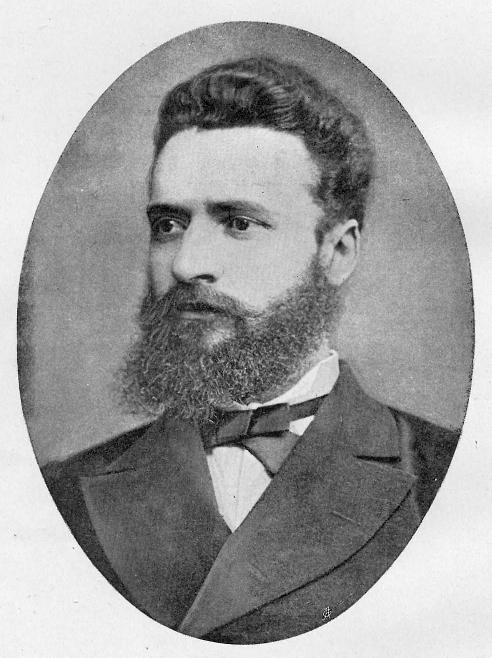
Hristo Botev - Bulgaria's most famous poet


I grew up with the Bulgarian culture and poetry of my ancestors in far off America. I learned the poetry of Hristo Botev and Ivan Vazov as a boy. I memorized “The Hanging of Vasil Levski” and “Hadji Dimitar” around the same time I was reading Whitman in English for the first time. Every time I read or recite those poems, I can heart my step-grandfather’s voice echoing in my ears. The man was not a poet. He was a banker, but he recited those poems like nobody else I knew with feeling, patriotism, and love.

I started writing poetry as a teenager. It was the kind of rhyming stuff that most people come up with at that age. It’s imitation Browning and Tennyson without the former’s sense of history and latter’s prosody. It could pass for Robert Frost on one of his worst days or even very young Hemingway. I remember giving it to a professor of mine in college. A wizened German woman named Ms. McAuley who gave me Ginsberg to read.
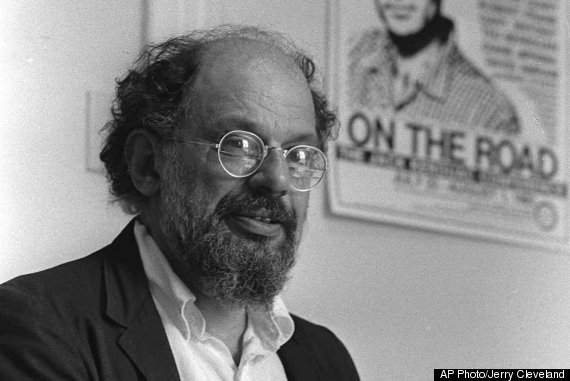
Allen Ginsberg 

I wrote poetry for years after that. I filled notebook after notebook and binder after binder with my chicken scratch. I consumed Komunyakaa and Adrienne Rich collections as if it were my birthright. I went to writing workshops, criticized the hell out of my classmates, and won the professor’s approval. I wrote about death, life, and everything in between. I was infatuated with poetry. I was madly in love with the possibility of sound.

I stopped writing poetry ten years ago. I’m not sure how it happened that the bottom dropped out. One moment, I was madly scribbling away. The next, my notebooks were gathering dust in the back of a closet together with old forms and letters and piano exam evaluations. I tried to write. I truly sat there for hours on end trying to find that single silver thread, but it never came.

One of the many books I read in Bulgaria. 

Going on my Fulbright, I found poetry again. Not only in the landscape of the country I was born in, but in the books I was reading. I ploughed through Lope de Vega, Dimcho Debelyanov, and a hundred other thin books of poetry as well as anthologies of well known authors. I taught the Shakespeare sonnets. I once managed to somehow declaim “The Raven.” I fell in love again.

Poetry is that one art that works when nothing else does. When we want to capture the mood of a moment, we can take a picture. It lasts for years, but we can also write poetry. The lyric poem is founded on that idea. It was something the ancient Greeks discovered a long time ago. The idea that we could compress a moment of time through words and preserve that image we saw before us.

Poetry preserves our memory, but it also moves. We write it because we need to express ourselves in a way that is not easily understood by those around us. We bare our souls in poetry and we allow others to empathize. You cannot read “The Raven” without pinpricks on your neck or “Song of Myself” without a feeling of inward exultation. For a few moments, we live in the poet’s world and it becomes our world. We see what he sees, we understand what he understands.


I am still a poet for I was born in a country that has given birth to them since Orpheus. While I may not write in iambic pentameter, rhyme, or use any other device, I am a poetry because I see the world as the poet does. It is a world of tremendous beauty as fragile as the leaf fall off a tree and twisting in the wind full of tragedy and joy. 

Monday, June 1, 2015

Turkish Atrocities in Macedonia, 1903

Peio K. Yavorov (1878-1914), Bulgarian poet and journalist 


During the current crisis in the Middle East, it is important and necessary to remember that mass killings of Christians have occurred before. Beginning in July 1903, numerous Bulgarians were butchered in Macedonia during the Ilindent Uprising. The following excerpts are taken from mimeographed newspapers that were published in  Bulgaria and edited by the Bulgarian poet Peio K. Yavorov (1878-1914). The translations are mine.

“The village of Nerezi was attacked and burglarized by Albanians and Turkish irregulars; 3 villages were killed. In the villages of Chereshovo and Golamani, there were numerous victims. In the village of Brezica, nine people were arrested and tortured to death.” 
 “In Gumendzha, the Turkish army leveled and destroyed the Bulgarian church. Within ten days’ time more than 200 people in the town and its surrounding areas were arrested.” 
 “Two or three weeks ago in Novo Selo, a spy was killed. Numerous innocent villages were accused of the crime and are sitting in prison, where they are the recipients of torture every day.” 
 “On the evening of August 7, the shepherd Kolio Donchev was attacked near the city of Strumica by a soldier and hit on the head with the butt of a rifle. The poor man lived through the most terrible sufferings for two days before he died.” 
“On the 19th of August in Thessalonica, twenty five people were freed from prison by the authorities. Having returned to their homes, they were once again arrested for no apparent reason.”
“The monastery of St. John in Veles was completely burned to the ground and destroyed by Turkish troops. Numerous people in the area of the monastery were arrested, tortured, and a killed.”


Source: Kolevski, V., Ed. Collected Works of Peio K. Yavorov, Vol. 4: Critical and Journalistic Works. Sofia: Bulgarian Writer, 1979.

Thursday, May 28, 2015

The Innate Conservatism of Bulgarian Culture


One of the perks of being a Fulbright alumnus is the fact that I serve as a mentor to other Fulbrighters who are going to Bulgaria. Not so long ago, I received an e-mail from one asking me for advice. She sent me a link to her blog wherein she wrote about her experiences. Unfortunately, her experience in the country was not positive and this post is simply an example of how frustrating her time as an ETA was for her.

You see, my friends, Bulgaria is a conservative country with a conservative culture. The things mentioned in the post are considered taboo. To a certain extent, the following rule applies to taboos in Bulgarian society - "If you don't talk about it, it doesn't exist." However, there is another rule that equally applies - "It's indecent and shouldn't be talked about at all." 

There are many topics that are not talked about in Bulgaria or swept under the rug. For example, very few people talk about domestic violence. It's something that happens all the time, but it's not something that is openly discussed outside the home. In Bulgaria, people believe that what they do is their business and nobody else's. To talk about something that happens inside the home to other people is the same as inviting those people into those house and showing them your dirty laundry. That is a massive faux pas in Bulgarian culture and society. 

To an extent that no longer exists in America, Bulgarians have the ability to draw a distinct line between their private and public selves. This division between the public and private self came into existence during the years of Ottoman occupation and was reinforced during the nearly fifty years of Communist oppression. During the Communist period, informers were used to infiltrate families and businesses. Saying one thing that could be construed as anti-Communist could land a person in jail for a considerable period of time. Children were taught from a young age that what they said to their friends and what was discussed at home were two different things which should not be mixed together. 


There is an old Bulgarian saying, "What was nobody's business became everybody's business." In a small country with a population of six million and in small cities and villages, gossip is a part of every day life. Stories spread faster than wildfire whether a person wants them to or not. When I was teaching in Plovdiv, I used to visit with my aunt (a cousin of my mother's). In our conversations, she would mention something about how I was doing at the school. When I asked her where she got the information, she would tell me that she received it from a friend. 

Now imagine if malicious backbiting gossip were to be spread about your family or your relatives in a small community The social consequences can be deadly. A person can be ostracized from the community or worse. Therefore, it is better for Bulgarians to close their eyes and ignore a problem rather than discuss it out in the open where other people can know about it. 

This clear division between what is public and what is private is one part of the conservatism I mentioned earlier. Another element is the fact that Bulgarians still have a very firm sense of what is right and what is wrong, what is good and what is evil. To a certain extent, this comes from the influence of the Bulgarian Orthodox Church. While many are not churchgoers, the Church's teachings on morals have been ingrained into the very fabric and psyche of modern Bulgarians. Whether liberal or conservative, they still know what is right and what is wrong. It is a very black and white world. A world which doesn't allow for shades of grey.

It is important for us to lay aside our ethnocentric views when living in other countries. It is necessary that we view the country and its people on its own terms rather than through whatever blinders we may have acquired as a result of being Americans. More importantly, we should learn to be tactful and diplomatic in our dealings with others. Whether we agree with them or not, we must learn not to impose our views on them and keep them to ourselves to avoid conflict. Only in this kind of environment can there be anything that remotely resembles an open exchange of ideas. 

Wednesday, May 27, 2015

Thoughts in a City Cemetery

Serbian cemetery, Fairmount Memorial Park. 


A cemetery is a place where I see the constant forward motion of humanity from one generation to another. In the cemetery I regularly visit, there is a large Serbian section. In the 1920s and 1930s, the earliest head stones are written in Cyrillic. Then, they are written in Cyrillic and English. Finally, they are written in English alone. Over the course of three generations, these immigrants were assimilated into American society.

Looking at these head stones, I often think about my journey. I was born in Bulgaria and came to America with my parents when I was a child. I grew up in this country, went to school here, and became an American. My parents live in the United States, but their minds are still in the Old Country. We still speak Bulgarian at home. My sister and I, however, are of the second generation. Our minds and our hearts are here in America and we speak English together.

The immigrant experience in America is similar no matter what country your ancestors came from. In the beginning, there was a period of adjustment and then came assimilation. The first language was lost, the ancestral religion was not kept, and assimilation took its course. Indeed, America is one of those countries which assimilates its immigrants very, very quickly. By the time my grandchildren and great-grandchildren are around, they will probably know only a little bit about my family and the fact that we came from a place called Bulgaria.

Many immigrant communities make strenuous efforts to keep the heritage alive. Churches are built and Saturday schools exist where children are educated in the language and history of their ancestral country. These institutions do not stop the assimilation process, but they act as an antidote to that which can be found in American society and as a powerful reminder that these young people, their parents, and grandparents came from a particular country with a particular outlook and a particular moral code.

In my own family, my mother made sure that my sister and I studied the Bulgarian language. We still speak it at home with our parents. Both of us can read it and my sister can write it. (Sadly, the only way I can write in Bulgarian is on a typewriter or computer. I never mastered cursive, which my sister did.) I taught myself a great deal about Bulgarian history by borrowing books from the library through Interlibrary loan and conversations with my parents as well as letters from relatives in the old country.

When I went back to Bulgaria in 2010, I felt a profound sense of homecoming. I had returned to the country of my roots. However, I also experienced a sense of alienation. The Bulgaria that existed in my memory, the one I had read about in book after book and poem after poem, was a country that no longer existed. There was very little in that Bulgaria of the country I had known as a child.

My return also taught me that I was not Bulgarian, but a Bulgarian American. While I still speak and read Bulgarian regularly, my roots are firmly in my adopted country. It is the place where I awoke to the world. While my Bulgarian background has shaped my outlook and my behavior, my life in America has made me the person that I am today and for that I am profoundly thankful.